










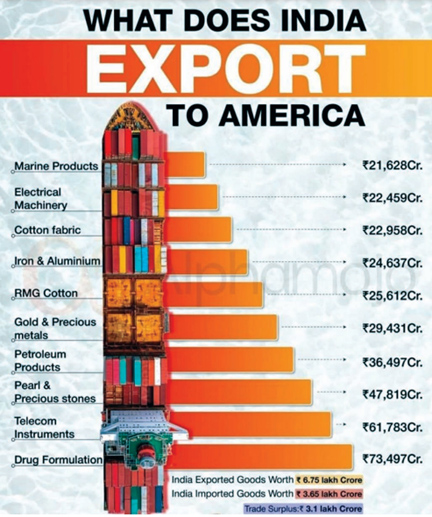
What Does India Export to US
 JUNE 2026 USTR MISSION: USTR Jamieson Greer visited New Delhi in June 2026 to resolve outstanding tariff schedules and digital trade parameters. Minister Goyal addressed speculation regarding stalled negotiations, emphasizing that both governments remain committed to an agreement that is balanced, commercially meaningful, and beneficial to businesses, farmers, workers, and consumers in both countries.
Domestic Politics: Agricultural Resistance vs. Export Ambitions
As negotiations progress, domestic political considerations continue to influence terms on both sides: Indian Agrarian Sensitivities: In states like Punjab, farm unions organized Mahapanchayats (large community gatherings) to protest proposed agricultural market access concessions. Farmers expressed concern that reduced tariffs on American dairy, genetically modified crops, apples, and poultry could undercut local livelihoods. U.S. Market Demands: American negotiators face pressure from domestic agriculture, medical technology, and digital service sectors seeking lower tariffs, transparent regulatory approvals, and relaxed data-localization requirements.
5. Strategic Horizon: Supply Chains, Defense, and Tech
While traditional trade disputes often focus on tariff lines, the strategic center of gravity in U.S.–India commercial ties has shifted toward hightech co-production and supply chain security.
I) SEMICONDUCTOR ECOSYSTEMS: Under iCET, major American semiconductor firms are investing heavily in Indian testing, assembly, and packaging facilities in Gujarat and Odisha. This integration positions India as a core alternative in global technology supply chains.
II) DEFENSE INDUSTRIAL COOPERATION: Moving away from standard buyer-seller deals, U.S. defense contractors are partnering with Indian stateowned and private firms to co-produce jet engines, armored vehicles, and maritime surveillance systems.
III) CRITICAL MINERALS: Signed under the Commercial Dialogue track in October 2024, the bilateral MoU on Critical Minerals secures supply chains for lithium, cobalt, nickel, and rare earth elements necessary for electric vehicle (EV) batteries, solar cells, and high-tech electronics.
6. The Indian American Community:
The Human Bridge At the center of this economic trajectory is the Indian American diaspora, serving as an irreplaceable catalyst for cross-border enterprise.
CORPORATE LEADERSHIP: Indian American executives leading major global technology, pharmaceutical, and financial services firms play a direct role in steering international investment and manufacturing capital toward Indian hubs.
ENTREPRENEURSHIP & CAPITAL: Silicon Valley and U.S. tech ecosystems feature strong venture capital corridors connecting American investment with Indian technology startups. This flow accelerates innovation across cross-border SaaS, artificial intelligence, fintech, and biotech.
POLICY ADVOCACY: Groups like the U.S.–India Business Council (USIBC), the U.S.–India Strategic Partnership Forum (USISPF), and regional diaspora chambers of commerce actively bridge capital, advocate for policy reforms, and build consensus across political parties in both Washington and New Delhi. Outlook: Navigating Ambition with Pragmatism As the United States and India move through 2026, their commercial relationship reflects a mature blend of economic interdependence and strategic alignment. The era when bilateral engagement was limited by Cold War mistrust or modest trade volumes has given way to an expansive economic engine exceeding $200 billion annually. Achieving the long-discussed goal of $500 billion in two-way trade will require steady political leadership and practical compromise on both sides. Washington must accommodate India’s unique domestic market needs, agricultural sensitivities, and strategic autonomy. At the same time, New Delhi must continue refining regulatory frameworks, lowering tariff barriers, and ensuring IP protection to remain an attractive destination for global capital. For Indian Americans, watching this relationship evolve offers both a source of pride and a tangible economic opportunity. As investors, executives, technologists, and community leaders, the diaspora remains uniquely positioned to help convert policy frameworks into enduring economic progress— ensuring that the U.S.–India commercial partnership serves as a central engine of global growth for decades to come.